The choice between renovating your existing home and scraping it to rebuild is the single largest financial decision most Boston-area homeowners ever make. Here's what MetroWest projects have taught us about getting it right.
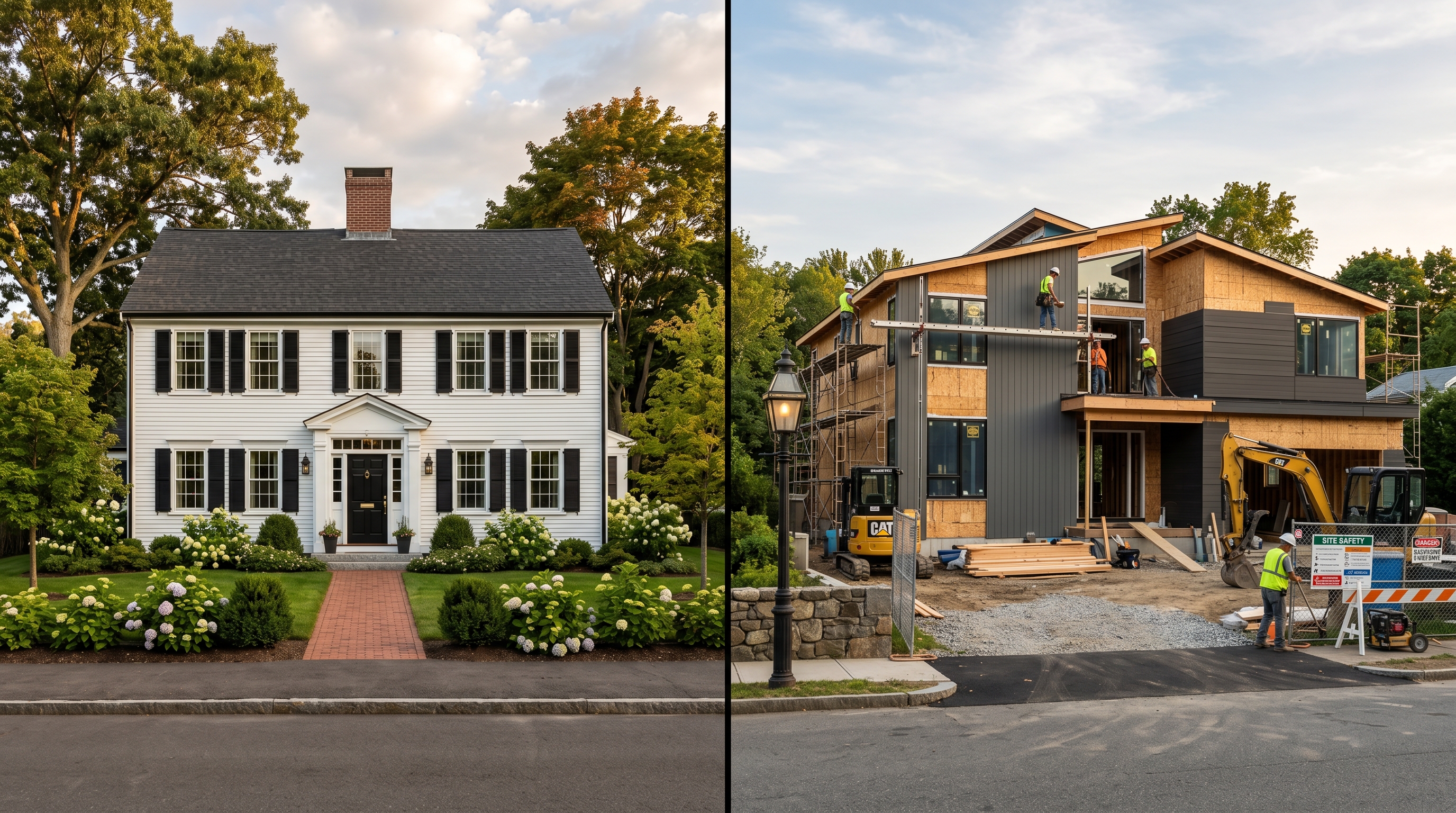
Renovate if the house has solid bones (foundation, framing, roof line you can live with), you love the lot and the neighborhood, or you sit inside a historic district where a tear-down won't be approved. You'll keep your tax basis, your trees, and probably 30-50% of the budget you'd spend on new construction.
Tear down and rebuild if the foundation is shot, ceilings are below 7'6", the floor plan can't be reworked around load-bearing walls, or you want a top-to-bottom modern envelope (insulation, HVAC, electrical, plumbing) and your zoning allows demolition. You'll spend significantly more, but you get exactly the house you want.
Most popular in Boston in 2026: Renovation still wins about 75% of our whole-home projects. Tear-downs are concentrated in Wayland, Sudbury, Weston, and parts of Newton outside the local historic districts.
Book a free design consultation and walk your home with the owner directly — what a renovation could achieve versus what a rebuild would cost. No salesperson. No pressure.
Book a Free Design ConsultationA whole-home renovation can mean anything from a deep cosmetic refresh to a full gut where everything but the foundation, framing, and roof structure goes in the dumpster. In Greater Boston in 2026, the typical scope we quote runs from a $500K kitchen-bath-floor refresh on a 2,500 square foot Colonial up to a $1.1M down-to-the-studs rebuild that adds dormers, opens up the main level, and replaces every mechanical system. The defining feature is that you keep the existing structural shell and the legal grandfathered footprint — which is what makes the math, the timeline, and the permits all easier than starting over.
A tear-down (sometimes called scrape-and-rebuild or knock-down rebuild) means demolishing the existing structure to the foundation, often the foundation too, and constructing a brand-new house in its place. In suburban MetroWest towns like Wayland, Sudbury, and Weston, this is increasingly the default for buyers who pay $1.2M for a tired 1960s ranch on a beautiful acre lot — they expected to demo it from day one. The headline cost in Greater Boston in 2026 runs $300 to $700+ per square foot, which puts a 2,500 square foot replacement build at $750K to $1.75M or more, plus $15K to $40K in straight demolition costs and another $20K to $60K in soft costs (architecture, engineering, permits, surveys, conservation filings).
Pricing for a typical 2,500 square foot single-family home, all-in (construction, design, permits, finishes — not land):
Pricing reflects Greater Boston market as of April 2026 and assumes a flat, accessible site with public utilities. Hillside lots, ledge, septic, and wetlands buffers each add meaningfully. Demolition adds $15K-$40K to tear-down totals.
Here's the pattern across Greater Boston: renovation still wins about three out of every four whole-home projects we quote, but the split varies sharply by town. In Brookline, Newton (especially the historic villages), Cambridge, and the inner-ring towns of Arlington, Belmont, and Watertown, the answer is almost always renovation — historic district commissions, demolition delay bylaws, and tight lots make tear-downs either impossible or politically miserable. In Wayland, Sudbury, Weston, Lincoln, and parts of Concord, we see far more tear-downs, often on tired 1960s ranches sitting on one to two acres where the land is worth more than the structure. Wellesley and Lexington sit in the middle: plenty of tear-downs, but only outside the local historic districts and only on lots that conform to current FAR and setback rules.
The single biggest mistake we see homeowners make is committing to a tear-down before they've gotten an honest renovation estimate from a builder who's actually opened up walls in their house. If a renovation can deliver 90% of what you want for 60% of the cost, the math is rarely worth the extra year of permits and the tax reassessment. The opposite mistake — committing to a renovation when the foundation is failing — usually surfaces three months in, when the discovery costs blow past the original budget and you end up doing a tear-down anyway, just more expensively.
Book a free design consultation and talk through both paths — a whole-home renovation or a tear-down rebuild — with honest numbers for each. Free for Greater Boston homeowners.
Book a Free Design ConsultationRenovating is almost always cheaper up front. Major full renovations run $200-$450 per square foot in Greater Boston, while tear-down and new build runs $300-$700+ per square foot. For a 2,500 sq ft home, that's roughly $500K-$1.1M to renovate vs $750K-$1.75M+ to scrape and rebuild — plus $15K-$40K in demolition costs alone before construction begins.
Renovation permits in most Greater Boston towns take 4-8 weeks if the work stays inside the existing footprint. Tear-down and new construction permits routinely take 6-12+ months because of demolition delay bylaws, zoning compliance review, conservation commission sign-offs, and historic district hearings in towns like Brookline, Newton, Cambridge, and Boston.
In most cases, no. Beacon Hill, Back Bay, parts of Brookline, Newton's local historic districts, and several Cambridge neighborhoods have demolition delay bylaws and historic commissions that effectively prohibit full tear-downs of contributing structures. You can usually still gut and renovate behind the original facade, but a true scrape-and-rebuild is rarely approved.
Yes. In towns like Newton, Wellesley, and Lexington, new construction typically sells for $200-$400 per square foot more than a renovated 1950s ranch on the same street. The catch: the up-front cost gap is much larger than the resale gap, so the math usually works only when you plan to live in the home for many years.
Tear down when the foundation is failing, framing is rotted or undersized, ceilings are below 7'6", the layout can't be reconfigured around load-bearing walls, or you want a fully modern envelope and your zoning allows demolition. Renovate when the home has good bones, you love the location and architecture, or the lot sits in a historic district.
Whether you renovate or rebuild, RD Horizon Builders has delivered both across Greater Boston for years. Free in-home consultation and an honest assessment of which path actually fits your house, lot, and zoning.