Need more space? You've got two real options — build out (or up) with an addition, or build down by finishing the basement you already have. Here's what MetroWest projects have taught us about which one actually fits your house, your budget, and your goals.
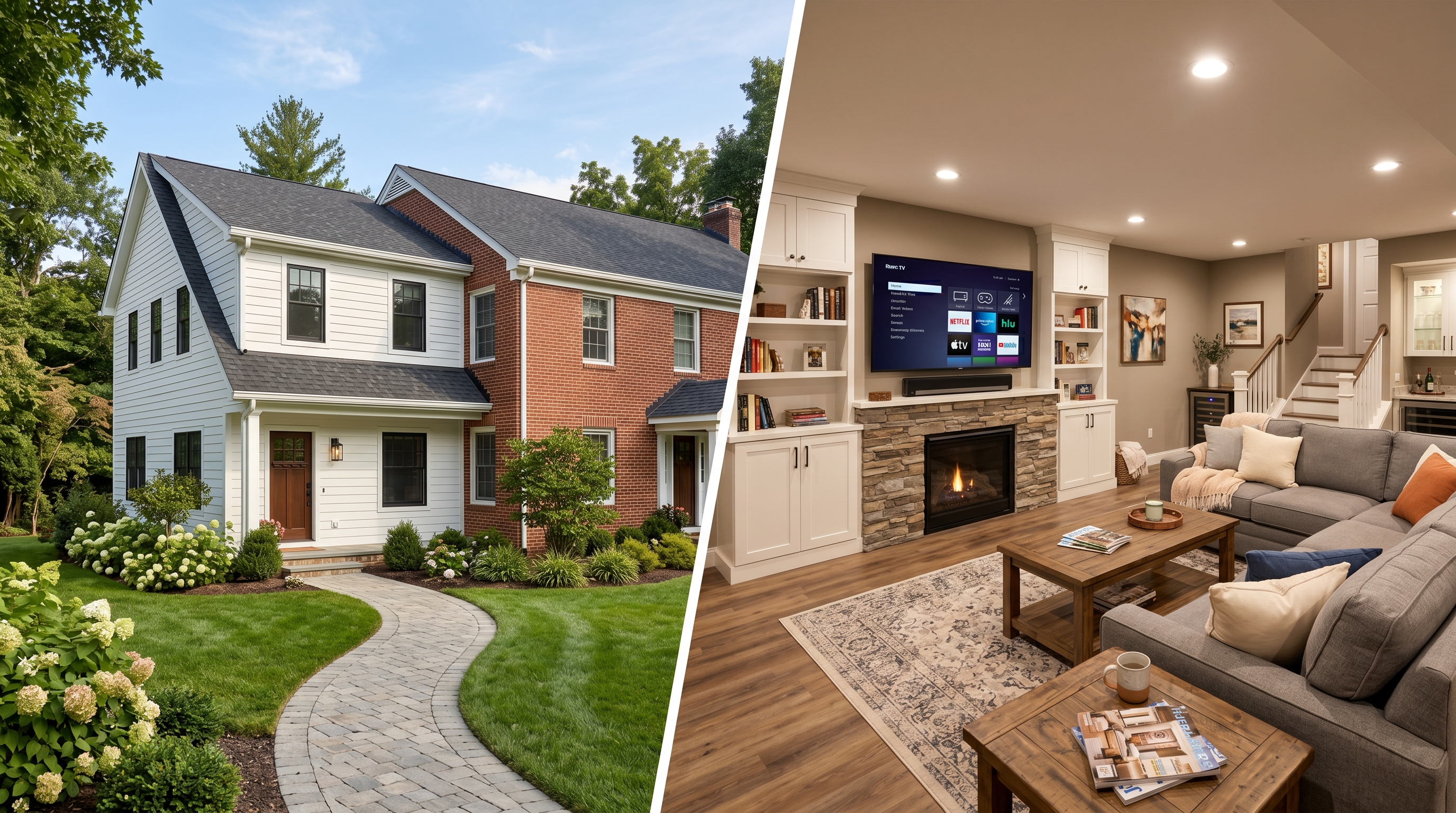
Finish the basement if you have at least 7' of ceiling height (after framing the floor and ceiling), the foundation is dry, and you mainly need rec space, a home office, a gym, a media room, or an in-law setup with proper egress. It's the fastest, cheapest way to add genuinely usable square footage to a Boston home.
Build an addition if you need legal bedrooms, a main-level primary suite, a real first-floor mudroom, or a kitchen/family expansion — anything that has to count toward MLS square footage and appraised value. Or if your basement simply isn't workable (low ceilings, chronic moisture, structural columns in the wrong places).
Most popular in MetroWest in 2026: Finished basements account for roughly 60% of our space-add projects, especially in Wayland, Sudbury, Natick, and Framingham where ranches and Colonials sit on full unfinished basements.
Book a free design consultation and Chris will walk your home with you, talk through what an addition could look like versus what your basement could become, and give you honest numbers for both.
Book a Free Design ConsultationA home addition adds new construction to an existing structure. In Greater Boston we typically build three flavors: a bump-out (200-400 sq ft, often a kitchen extension, family room expansion, or first-floor primary suite), a full addition (400-1,000+ sq ft, sometimes two stories, often used for an in-law wing or a real primary suite plus bedrooms above), and a second-story add-up (essentially doubling the existing footprint by going vertical, common on tight Newton and Brookline lots where horizontal expansion is impossible). Cost in 2026 sits at $250 to $500+ per square foot, putting a 400 square foot addition at roughly $100K to $200K and a full 800 square foot two-story addition north of $300K once finishes are dialed in.
Finishing a basement converts existing below-grade space — concrete walls, slab, exposed joists overhead, the furnace and water heater somewhere in the corner — into framed, insulated, drywalled, conditioned living space. The structure is already there, so you're paying mostly for framing, insulation, electrical, plumbing (if you're adding a bath or wet bar), HVAC tie-in, drywall, flooring, doors, and trim. In Greater Boston in 2026, a typical 800 square foot finished basement runs $40K to $96K all-in, or $50 to $120 per square foot depending on whether you're adding a full bath, a kitchenette, or a legal in-law unit with an egress window.
Pricing for a typical 400 square foot addition versus an 800 square foot basement finish, all-in:
Pricing reflects Greater Boston market as of April 2026 and includes design, permits, construction, and standard finishes. Additions assume slab-on-grade or crawl-space foundation; full basement under the addition adds $30K-$60K. Basement pricing assumes adequate ceiling height and a dry foundation.
Here's the pattern across Greater Boston: basement finishing is the runaway favorite in MetroWest, where homes in Wayland, Sudbury, Natick, Framingham, Hopkinton, and Ashland typically sit on full, dry, 8-foot-ceiling basements that finish beautifully. We routinely take 1,000-1,500 square foot basements in those towns and turn them into rec rooms, gyms, theaters, offices, and full in-law suites for $60K-$120K. The catch: it requires a basement that was actually built with finishing in mind, which is true of nearly every home built after about 1985 and surprisingly few before.
In the inner ring — Newton, Brookline, Watertown, Cambridge — additions often dominate, but for the opposite reason. Lots are tight, basements are short and cramped, and homeowners need legal bedrooms and main-level primary suites that the basement can't provide. Second-story add-ups are particularly common in Newton's villages, where horizontal expansion would consume what little yard exists. Wellesley, Lexington, and Concord see the fullest mix: tear-down or large addition for the families that want a forever home, and finished basements for families who already have the bedroom count they need and just want a place to put the kids' Xbox.
The biggest mistake we see homeowners make is starting with the question "what should we build?" instead of "what problem are we actually solving?" If you need a fourth bedroom, a basement won't fix it. If you need a media room and a home gym, an addition is wildly overpriced for the job. The right answer almost always falls out of an honest conversation about what's missing from your daily life — not from looking at Pinterest.
Book a free design consultation and talk through both paths — an addition or a finished basement — with the owner who would build it. Free for Greater Boston homeowners.
Book a Free Design ConsultationFinishing the basement is dramatically cheaper. Basement finishing runs $50-$120 per square foot in Greater Boston, so an 800 sq ft basement typically costs $40K-$96K. A home addition runs $250-$500+ per square foot, so a 400 sq ft addition typically costs $100K-$200K+. Per square foot of usable space, basements deliver roughly 4-5x more space for the same money.
No. Under MA assessing and MLS conventions, finished basement space below grade does not count toward legal living area or appraised gross living area. It still adds usable space and meaningful resale value, but a 400 sq ft addition that adds legal square footage will appraise differently than 400 sq ft of finished basement.
A home addition in Greater Boston typically takes 4-9 months from permit to completion. Finishing an existing basement typically takes 4-8 weeks because the structure already exists. The permit process is also faster for basements — building permit only, no zoning or setback review.
On a percentage-of-cost basis, finished basements outperform additions in Greater Boston. Finished basements typically recover 70-86% of cost at resale; additions recover roughly 50-65%. In absolute dollars an addition adds more total value because it costs more, but the basement is the more efficient use of remodeling budget.
MA building code generally requires a minimum 7' finished ceiling height in habitable basement rooms. Below that, the space cannot legally be used as living area. We frequently see 1950s and 1960s ranches in MetroWest with 6'8" basement ceilings that can't be finished as code-compliant habitable space without underpinning the foundation.
Whether you build out or build down, RD Horizon Builders has done thousands of additions and finished basements across Greater Boston. Free in-home consultation and an honest take on which path fits your house.