Tile vs Acrylic Shower: The Honest 2026 Comparison
The shower is the part of your bathroom that gets used hardest, leaks first, and dates fastest. Choose wrong and you're either ripping out a one-year-old insert or living with grout you hate. Here's what Greater Boston bathroom remodels have taught us.
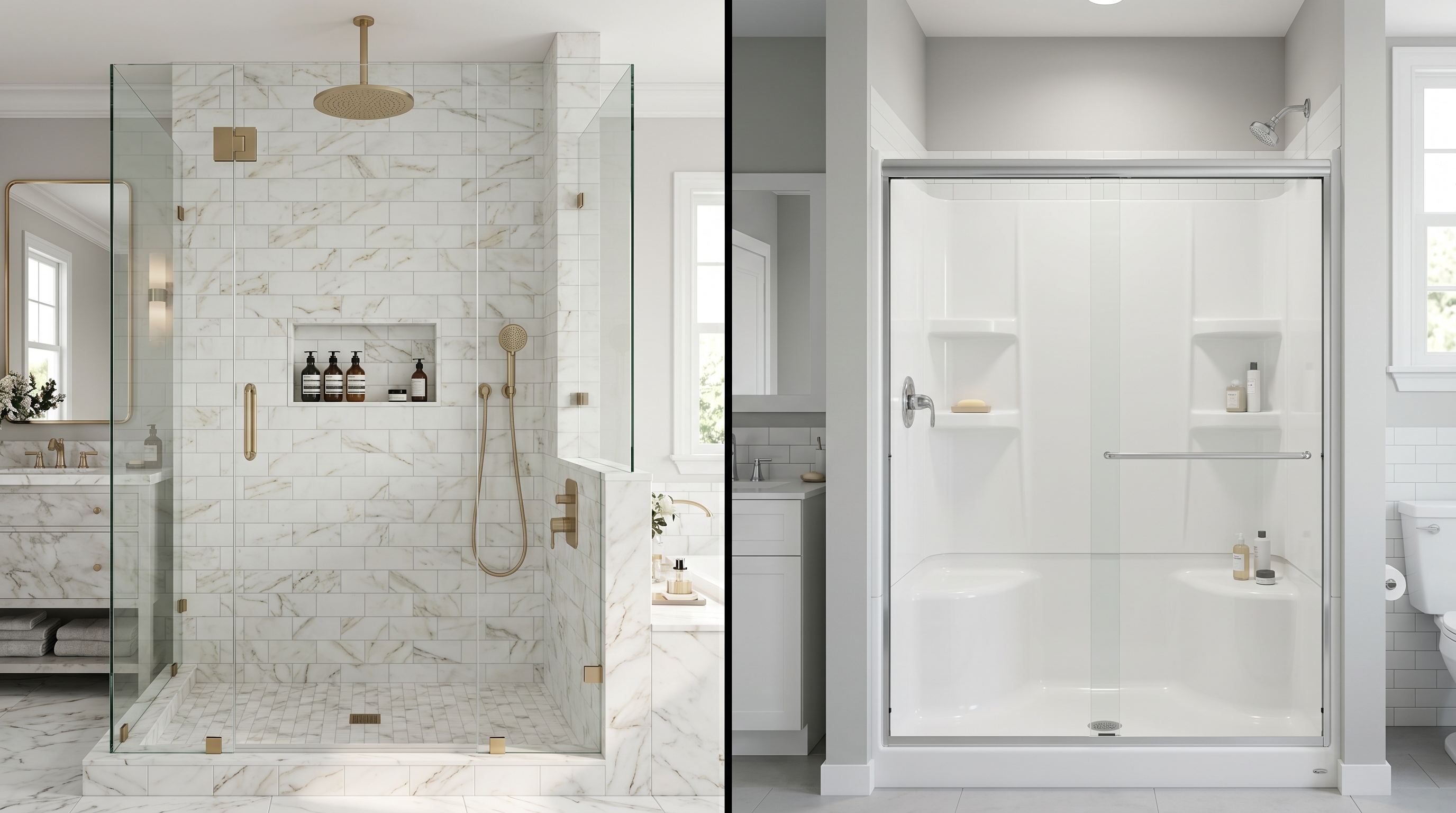
Custom tile (left) gives unlimited design freedom and decades of life. Acrylic (right) gives speed, simplicity, and built-in safety features at about a third of the cost.
Quick Verdict
Choose Custom Tile if this is your forever home, this is the primary bathroom, and you want maximum design freedom, longest lifespan, and the highest resale lift.
Choose Acrylic if you need a fast refresh, this is a rental or secondary bath, the budget is tight, or you need built-in seats and grab bar mounts for aging-in-place.
Most popular in Boston in 2026: Custom tile wins about 65% of our primary-bath remodels. Acrylic wins about 80% of secondary, basement, and rental-unit bathrooms.
See Both Options in YOUR Bathroom — Free
Book a free design consultation and Chris will walk your bathroom with you, compare custom subway tile against a clean acrylic insert, and give you honest numbers for both.
A custom tile shower is the result of a real waterproofing system underneath, not the tile on top. The build sequence is: framing, cement backer or foam board, a fully bonded waterproof membrane (we use Schluter Kerdi or USG Durock RedGard), a sloped pre-pitch and final mortar bed for the pan, then thinset, tile, grout, sealer, and a tempered glass enclosure measured after the tile is set. Done right, the shower lasts 30 to 50 years and the only maintenance is occasional re-sealing of the grout.
The 3 Things We Hear Boston Homeowners Love
Unlimited design freedom. Subway, large-format porcelain, mosaic floor, hand-glazed zellige, herringbone, marble, slab walls — if you can find it at the showroom you can put it in your shower. Niches go where you want them, the bench is the size you want, the curb is the height you want.
It looks expensive because it is built right. A clean tile shower with a frameless glass panel is the single most photographed feature in a Boston primary-bath remodel. It signals quality the moment a buyer walks in.
It lasts a generation. Tile from a 1995 Newton bath we updated last year still had perfect waterproofing under the floor. We replaced the dated glass and kept the tile. Try that with an acrylic insert.
The 3 Things to Watch Out For
Grout is a maintenance item. Even with a quality penetrating sealer, grout joints get re-sealed every 5 to 10 years and may need a full re-grout at year 15. Epoxy grout extends that timeline but adds cost.
Bad waterproofing equals expensive failures. If the membrane behind the tile is installed wrong, water gets behind the tile and rots the framing. By the time you see a stain on the ceiling below, the damage has been growing for a year. Hire someone who installs Kerdi or RedGard correctly and gets it inspected.
Long install timeline. Plan for the bathroom to be out of service for 5 to 10 working days. The cure schedule for membrane and thinset can't be rushed and the tempered glass enclosure adds a 7-10 day fabrication wait after final tile.
Acrylic Shower Inserts: The Fast, Reliable Refresh
An acrylic shower insert is a single-piece (or three-piece, for retrofits where doorways are tight) molded shower stall — walls, floor, and curb in one unit, with the plumbing rough-in connected on site. Premium brands we install include Bath Fitter, Sterling, Aquatic, and Onyx Collection. Modern units have realistic textured wall patterns, optional shelving, factory-mounted grab-bar reinforcement, and built-in molded seats. Install start to finish is 1-2 days because there is no waterproofing layer to cure.
The 3 Things We Hear Boston Homeowners Love
Speed. Demo Monday morning, working shower Tuesday night. For families with one bathroom, Airbnb hosts, or anyone refreshing a unit between tenants, that timeline is the entire reason to pick acrylic.
Built-in safety features. Factory-installed seats, slip-resistant floor texture, and reinforced wall blocking for ADA-compliant grab bars are standard on aging-in-place models. Custom-tile bathrooms can get there but require more planning, more cost, and more design coordination.
Zero grout, zero maintenance. Wipe with a soft non-abrasive cleaner once a week and the surface stays new. No re-sealing, no re-grouting, no mildew in joints because there are no joints.
The 3 Things to Watch Out For
Limited customization. You pick from preset sizes, a handful of textures, and a short list of colors (almost always white, off-white, or biscuit). If you wanted zellige and a stone bench, this is not the product.
Shorter lifespan. 15-20 years before the surface dulls, scratches accumulate, or the substrate flexes and cracks. Replacement means a full pull-out, not a tile swap.
It can read "rental-grade" in a primary bath. A Wellesley buyer touring a $1.8M home expects a tile shower in the primary bath. An acrylic insert in that room is a value-engineering signal that affects the offer.
2026 Cost Breakdown for Boston Bathrooms
Pricing for a typical 32" x 60" alcove shower, fully installed (demo, plumbing, install, enclosure):
Tier
Custom Tile
Acrylic Insert
Builder-grade
$4,000-$6,500 (subway, framed glass)
$1,500-$2,500
Mid-range
$6,500-$10,000 (porcelain, semi-frameless glass)
$2,500-$3,500 (with seat, grab bars)
Premium / Custom
$10,000-$15,000+ (marble, zellige, frameless)
$3,500-$5,000 (premium texture, full ADA)
Pricing reflects Greater Boston market as of April 2026 and includes demo, framing if needed, plumbing, waterproofing, surface, and enclosure. Excludes valve/fixture upgrades, lighting, vent fan, and tile floor outside the shower footprint.
What We've Seen in Family-Owned of Boston Bathrooms
The split is sharper than people expect. In primary bathrooms in Newton, Wellesley, Brookline, Lexington, and Weston, custom tile wins almost every job — buyers in those towns simply expect it, and the lift in resale more than covers the extra $4,000-$8,000. We have not installed an acrylic insert in a primary bath in those towns in years. The story flips completely in:
Secondary, hallway, and basement bathrooms across MetroWest — when the goal is a clean working second shower for guests and kids, an acrylic insert is the right answer. Spending $10,000 on a basement shower nobody photographs is a waste.
Rental units and condos in Allston, Brighton, Somerville, Cambridge, and Watertown — landlords want fast, durable, easy to clean between tenants, and resistant to bad-tenant abuse. An acrylic insert covers all four boxes.
Aging-in-place bath conversions in Newton, Needham, Natick, and Framingham — when a homeowner is converting a tub to a shower for safe entry, the factory-built seat and grab bar reinforcement on a quality acrylic unit is genuinely the right product. We can do all of that in tile, but the build is twice the cost and twice the timeline for a feature that is functionally identical.
In-law suite and ADU baths in Newton's village neighborhoods and Arlington — secondary-importance baths in primary-importance homes get acrylic without harming the home's value.
The reality our project managers track: about 65% of primary-bath jobs are tile, about 80% of secondary/basement/rental jobs are acrylic, and the homeowners who pick the wrong product for the room are the ones who call us 3 years later wishing they had picked the other one.
Stop Imagining. Start Visualizing.
Book a free design consultation and compare a custom tile shower against a clean acrylic insert for your bathroom — honest numbers for both. Free for Greater Boston homeowners.
Is a tile or acrylic shower better for a Boston bathroom?
For a primary bathroom in a forever home, custom tile is the better choice — it lasts 30-50 years, allows unlimited design, and adds significantly more resale value. For a secondary bath, rental, fast refresh, or aging-in-place upgrade, an acrylic insert is the smarter call. It installs in 1-2 days instead of 5-10 and costs about a third as much.
How much does a custom tile shower cost in Boston in 2026?
A custom tile shower in Greater Boston costs $4,000-$15,000+ in 2026, fully installed. Standard subway-tile builds are at the low end; large-format porcelain, zellige, marble, and frameless glass enclosures push above $15,000. The price covers waterproofing membrane, curb, niche, tile, grout, glass, and fixtures.
How much does an acrylic shower insert cost in Boston in 2026?
An acrylic insert shower in Greater Boston costs $1,500-$5,000 installed in 2026, including the prefab unit, plumbing rough-in, valve, drain, and basic enclosure. Aging-in-place models with built-in seats and ADA grab bars run at the higher end of that range.
How long does each shower take to install?
An acrylic insert installs in 1-2 days from demo to functional shower. A custom tile shower takes 5-10 working days because of waterproofing cure time, tile setting, grout cure, and tempered glass fabrication (typically 7-10 business days after final tile measurement). Plan for the bathroom to be unusable the entire time on a tile job.
Which adds more resale value, tile or acrylic?
Custom tile adds significantly more resale value than acrylic in Greater Boston, especially in primary bathrooms. Buyers in Newton, Wellesley, Lexington, and Brookline read tile as a quality signal and acrylic as builder-grade. In a secondary bath, basement bath, or in-law suite, a clean acrylic insert is fully acceptable and does not hurt resale.
Ready to Build It?
Whether you choose a custom tile build or a fast acrylic refresh, RD Horizon Builders has installed thousands of showers across Greater Boston. Free in-home consultation.