Floors are the surface you stand on every minute you're home. Pick the wrong one and you'll either re-floor in 15 years or live with water damage in your kitchen. Here's what Greater Boston flooring jobs have taught us.
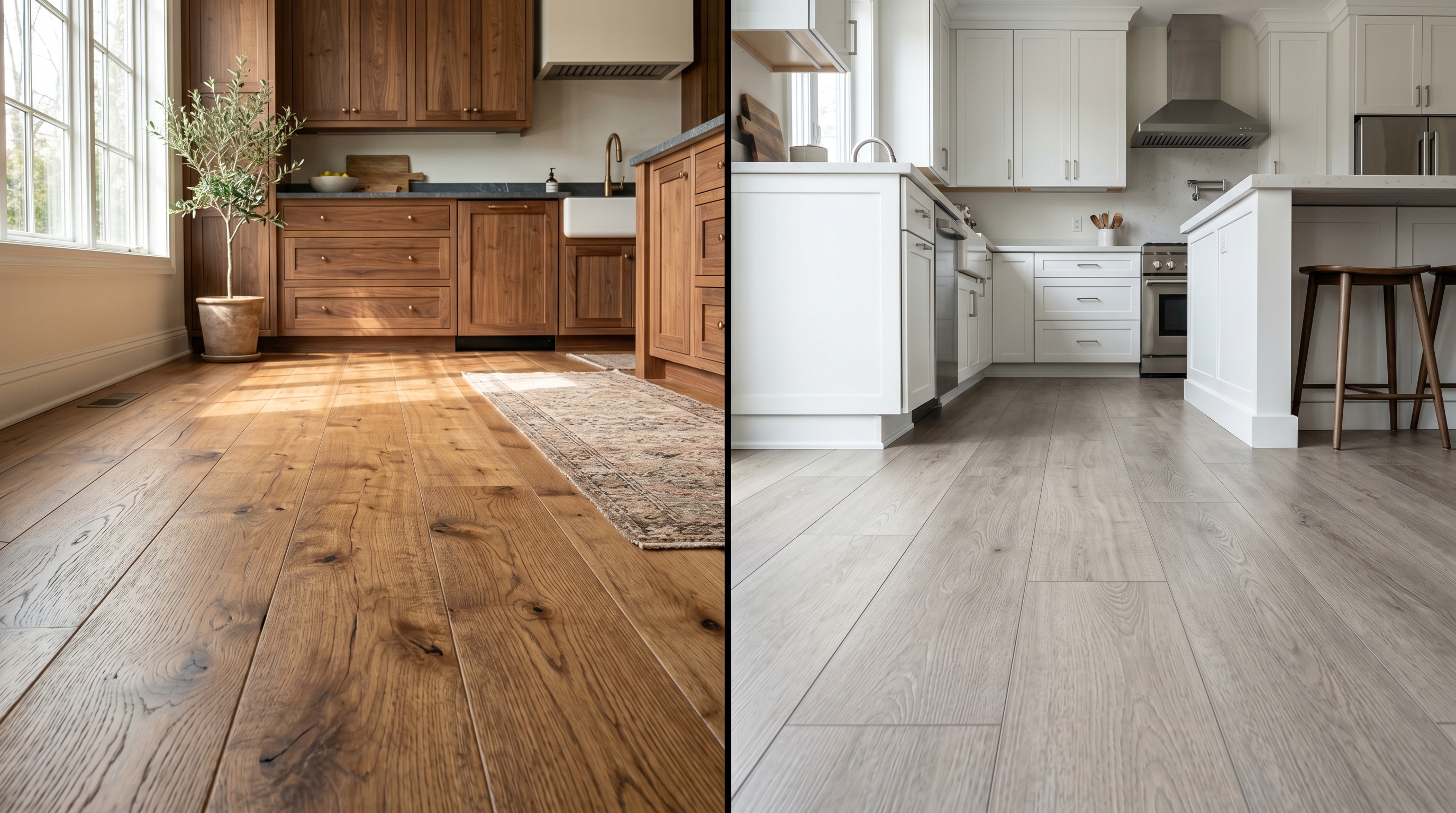
Choose Hardwood if the floor is going in main living areas, hallways, dining rooms, or bedrooms in a single-family home above grade — and you plan to stay (or want maximum resale).
Choose LVP if the floor is going in a kitchen, full bathroom, mudroom, finished basement, rental unit, or any space with moisture, kids, dogs, or a tight budget.
Most popular in Boston in 2026: A blend. About 60% of our flooring projects use hardwood upstairs and LVP in basements and wet rooms. Pure-LVP whole-house jobs are common in rentals, condos, and starter homes.
Book a free design consultation and Chris will bring hardwood and LVP samples, walk your rooms with you, and give you honest numbers for both.
Book a Free Design ConsultationHardwood comes in two forms we install in Boston homes: solid hardwood (3/4-inch milled planks of red oak, white oak, walnut, hickory, or maple) and engineered hardwood (a real-wood veneer bonded to a plywood or HDF core). Solid is the gold standard above grade; engineered is the only true wood approved over concrete slabs and radiant heat. Either way, the surface is real tree — it has grain, it ages, and it can be brought back from almost any abuse with a sander.
Luxury vinyl plank is a multi-layer rigid plank — typically a printed photographic wood-look layer over an SPC (stone-polymer composite) or WPC (wood-polymer composite) core, sealed under a clear urethane wear layer measured in mils (thousandths of an inch). The wear layer is what separates a 5-year rental-grade product from a 25-year residential-grade product. In Boston we install brands like COREtec, Karndean, Shaw Floorté, Mohawk RevWood, and LL Flooring CoreLuxe with 20-30 mil wear layers for residential work.
Pricing for a typical 500 square foot installation, materials and labor included:
Pricing reflects Greater Boston market as of April 2026 and includes material, install, basic prep, and standard transitions. Excludes subfloor repair, removal of existing flooring, stair treads, and trim replacement.
The pattern in Greater Boston is remarkably consistent: hardwood is the standard upstairs and LVP owns everything else. In Newton, Wellesley, Brookline, Weston, and Lexington, almost every full home renovation we touch ends up with site-finished white oak in the main living areas, hallways, and primary bedroom. That has not changed in 20 years and it will not change soon — buyers in those towns expect it. Below grade and in wet rooms, LVP wins:
The combo we install most often in 2026: solid 4-inch white oak in the living room, dining room, hallways, and bedrooms; premium SPC LVP in the kitchen, mudroom, full bath, and finished basement. A clean wood-look transition strip at the kitchen entry is the only design tax. The result is a floor system that respects each room's reality.
Book a free design consultation and see how white oak hardwood and premium LVP would work room by room in your home. Free for Greater Boston and MetroWest homeowners.
Book a Free Design ConsultationFor main living areas in single-family homes — especially Newton, Wellesley, and Brookline — hardwood is the better long-term investment. It refinishes 5 to 10 times across a 50-100+ year lifespan and adds 2.5-5% to resale. LVP is the better choice for kitchens, full baths, mudrooms, and any below-grade space because it is 100% waterproof and zero-maintenance.
Engineered hardwood in Greater Boston costs $8-$15 per square foot installed in 2026. Solid red oak, white oak, and walnut run $12-$25 per square foot installed depending on board width, grade, and finish. A 500 sq ft living room with site-finished solid white oak runs $7,500-$12,500.
LVP in Greater Boston costs $4-$10 per square foot installed in 2026. Builder-grade click-lock LVP starts around $4 per sq ft; premium SPC products with 20-30 mil wear layers reach $9-$10. A 500 sq ft finished basement typically runs $2,000-$5,000.
Yes — that combination is the most common pattern we install in Greater Boston in 2026. Hardwood handles upstairs main living areas; LVP handles the kitchen, baths, mudroom, and basement where moisture makes solid hardwood a poor choice. Color-matched transitions at the basement stair top are the only design step that needs care.
Hardwood adds 2.5-5% to home sale price in Greater Boston; LVP adds 1-2%. In premium markets like Newton, Wellesley, Brookline, and Lexington, listing photos showing real hardwood in main living areas signal value to both buyers and appraisers. LVP is appropriate (and even preferred) in basements and wet rooms but does not carry the same premium upstairs.
Whether you choose hardwood, LVP, or a smart combination of both, RD Horizon Builders has installed hundreds of thousands of square feet of flooring across Greater Boston. Free in-home consultation.